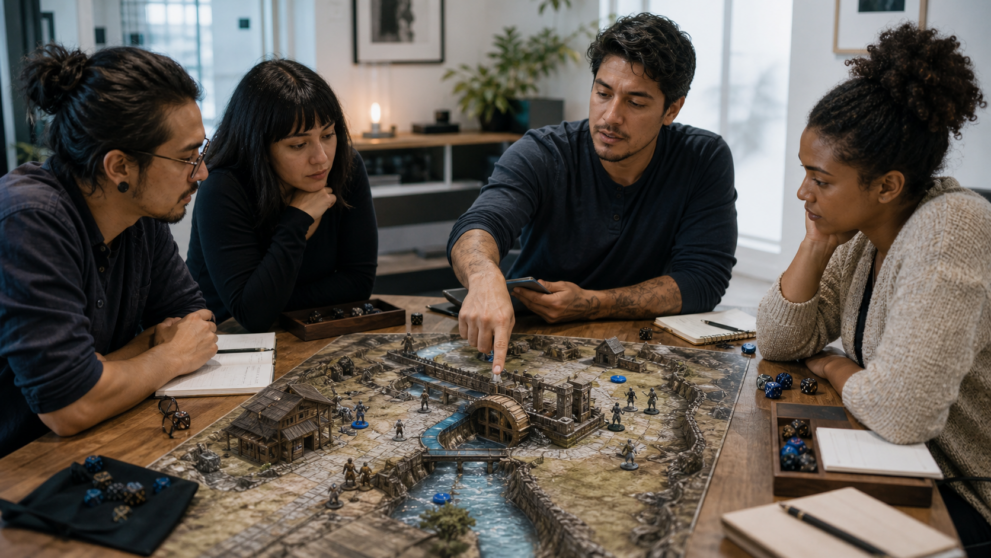
Game Map: Build Places Your Players Can Push Against.
Your AI drew you a place. Nobody could have built it.
Tactical space, location art, and maps that exist inside the fiction.
A generated map is a picture of a place. It is not a place.
The rooms connect because a model put them next to each other. The cave appears halfway down a corridor for no reason. There is one way in, nothing narrows, and nowhere is worth holding. It looks right on the page and plays flat at the table.
WHAT IT DOES
Tell it what happens there. Get the ground it happens on.
Not what the space looks like, but what happens in it. “They have to get through the mill before the men on the road catch up.” That is enough. You get five zones, a chokepoint at the sluice gate, and a threshold where the water starts rising.
THE MECHANISM
The structure comes first, so the picture can never contradict it.
→ Causal history: writes what happened here before it draws anything. Every feature traces back to that chain of events, or it gets removed.
→ Functional geography: checks chokepoints, sightlines, sound, retreat difficulty, escalating risk, and verticality. A failed space gets rebuilt rather than delivered.
→ Architectural plausibility: establishes terrain, entrances, shared walls, and the reason built space meets natural space.
→ Thresholds: names the events that permanently change how the space works and tells players what could happen before they cross it.
→ Three tracks: builds a space to fight in, a place to show, or a map that exists inside the fiction as an object to find, steal, or misread.
→ Question dial: decides everything, asks three questions, or builds with you in stages. You set the dial once.
Can’t I just do this with ChatGPT?
Yes. That is the problem.
Ask ChatGPT to build you a dungeon and it will build you a dungeon. It will be plausible, it will be fast, and it will have no chokepoints, no reason to exist, and no history that explains why the room is where it is. You will not notice, because you asked for a dungeon and you got one.
A lens makes the same model do the work it skips: name the ground the place was built on, state what changes when the alarm goes off, mark the one connection that decides the fight, and tell you which of those it is guessing at.
The model was always capable of that. Nobody was asking it to.
Who this is for
GMs who improvise locations – and need them to hold up once players start poking at the walls.
Anyone whose AI maps look right and play wrong – plausible geometry with no tactical decisions in it.
Writers who need a place, not a description – somewhere with a history that shows.
$10 – One PDF. Works on ChatGPT, Claude, Gemini, DeepSeek, and Grok. One-time purchase.
Not an app. A document. Nobody can take it out of your plan.
It builds the ground. What walks on it is your call.